

Showing posts with label italy. Show all posts
Showing posts with label italy. Show all posts
Expanded Venice, Bridge by Bridge edition available now!
The expanded 2019 edition of Venice, Bridge by Bridge is out now on Amazon! And to say thank you to all the followers here on Facebook, the e-book version is available for FREE, on 13 & 14 June only! All I ask in return is that you review the book once you've had a look. This edition has an added section on the bridges of Chioggia, the hidden gem of the Venice Lagoon, also known as "Little Venice". Even better, why not get the free e-book and order a copy of the print edition as a gift for the Venetophile in your life.


The Bridges e-book is now in the Amazon Kindle Store!
To celebrate the final chapter of the One Hundred Bridges Challenge, I've published the story of the Challenge in an eBook you can now buy on the Amazon Kindle Store! The stories of all 100 bridges plus a bonus or two are in there, plus the photos I took along the way!
Whether you read books on Kindle, iPad, or any of the myriad of smartphones and Android devices about there, the eBook fits them all.
So if you have five dollars or so to spare, click or to the Amazon Kindle Store and get yourself a copy.

Whether you read books on Kindle, iPad, or any of the myriad of smartphones and Android devices about there, the eBook fits them all.
So if you have five dollars or so to spare, click or to the Amazon Kindle Store and get yourself a copy.

Bridge One Hundred - Ponte de Gheto Novo - We've made it!
We rounded a corner leading out of the square and there it was - bridge number one hundred, the Ponte de Gheto Novo! For a moment we stood still at the foot of its wide cast iron arch, and as if on cue a bunch of boisterous teenagers came rushing across the bridge looking like they were sent to welcome us home, their footsteps clattering loudly on the metal steps. We started slowly up the steps, savouring the moment and pausing at the bridge's crest to look out over the canal where the lights illuminating the Fondamenta dei Ormesini alongside it shimmered in the water.

It was a fine moment. Footsore, suffering from mild sunburn and hungry we felt slightly lost, the way a long-distance athlete feels after completing a marathon. And a marathon it was - we'd climbed more than two thousand steps to get to this point. Yet the satisfaction gained from completing the day successfully made it all worthwhile.
We'd done something no one has previously done consciously - walked across and photographed one hundred bridges in Venice in a day. It was a personal challenge for me, to accomplish something a bit extraordinary like this. It wasn't a race and I won't get into the Guinness Book of Records, but I still felt proud, both of myself and Adeline. As a couple we'd made history for ourselves as well.

From the last bridge we crossed, it was a slow walk along the canal and through a neighbourhood fast asleep to the deserted S. Alvise vaporetto stop. Along the way, we shared the last few drops in Adeline's water bottle and found half a chocolate bar in her backpack to help give us a final burst of energy to get home. At the vaporetto station, waiting for the boat to arrive we could see the faint lights of Murano in the distance across the water winking at us, calling us to bed. We'd reached our goal, the job was done. We'd conquered one hundred bridges in Venice.
If you'd like to read the full story of the Challenge, you can find the e-book with details of all one hundred bridges on Amazon Kindle Store.

It was a fine moment. Footsore, suffering from mild sunburn and hungry we felt slightly lost, the way a long-distance athlete feels after completing a marathon. And a marathon it was - we'd climbed more than two thousand steps to get to this point. Yet the satisfaction gained from completing the day successfully made it all worthwhile.
We'd done something no one has previously done consciously - walked across and photographed one hundred bridges in Venice in a day. It was a personal challenge for me, to accomplish something a bit extraordinary like this. It wasn't a race and I won't get into the Guinness Book of Records, but I still felt proud, both of myself and Adeline. As a couple we'd made history for ourselves as well.

From the last bridge we crossed, it was a slow walk along the canal and through a neighbourhood fast asleep to the deserted S. Alvise vaporetto stop. Along the way, we shared the last few drops in Adeline's water bottle and found half a chocolate bar in her backpack to help give us a final burst of energy to get home. At the vaporetto station, waiting for the boat to arrive we could see the faint lights of Murano in the distance across the water winking at us, calling us to bed. We'd reached our goal, the job was done. We'd conquered one hundred bridges in Venice.
If you'd like to read the full story of the Challenge, you can find the e-book with details of all one hundred bridges on Amazon Kindle Store.
Bridge Ninety-Nine - Ponte de Gheto Novissimo
Our final goal in the Challenge was the Jewish Ghetto, an area where Jewish people were traditionally separated from the rest of Venice, since 1516. Venice was the first state in history to do this (it also did so with other nationalities, not only Jews). This area was closed off during the night in that time, and the two bridges that are our final destination were closed off and guarded. But fortunately, tonight, both would be open allowing everyone to move freely across them.
The first of the two bridges caused us some confusion. According to our information the one we faced was named 'Ponte de Gheto Novissimo', yet the sign above the wood and stone bridge with its neat wooden railings read 'Ponte de Gheto Novo', which in fact would be the final bridge.

Whatever, we weren't going to split hairs at this time of night, after encountering ninety-eight other bridges. So we walked across into the Campo de Gheto Novo which forms the heart of the Jewish Ghetto. It was brightly lit, quiet and peaceful. The few people we saw around included two rowdy friends exiting a restaurant that was closing, and two Hassidic gentlemen quietly chatting together in a doorway. Other than that we were the only two people around.
The first of the two bridges caused us some confusion. According to our information the one we faced was named 'Ponte de Gheto Novissimo', yet the sign above the wood and stone bridge with its neat wooden railings read 'Ponte de Gheto Novo', which in fact would be the final bridge.

Whatever, we weren't going to split hairs at this time of night, after encountering ninety-eight other bridges. So we walked across into the Campo de Gheto Novo which forms the heart of the Jewish Ghetto. It was brightly lit, quiet and peaceful. The few people we saw around included two rowdy friends exiting a restaurant that was closing, and two Hassidic gentlemen quietly chatting together in a doorway. Other than that we were the only two people around.
Bridge Ninety-Eight - Ponte de l'Anconeta
While walking alongside the still waters of the Rio della Maddalena we passed a well-lit restaurant filled with socialising patrons. The atmosphere, which moments before had been quiet and solemn, changed instantly to gay and exuberant. The sounds of laughter, patrons chattering, and the clinking of glasses and plates floated across the canal which was lit with reflections from sidewalk lights. It was a pretty scene, and for a moment we speculated about sitting down for a quick snack. But tiredness was taking its toll on both of us, and so we moved along to the Ponte de l'Anconeta, our third last bridge.

We'd hardly left the bright, convivial restaurant scene when once again we were enveloped in a dark ghostliness with hardly a soul around. It might have been the cold, or perhaps the ghost of a long-forgotten Venetian soul still restlessly wandering the city, but we walked on in a hurry, the end now plainly in sight.

We'd hardly left the bright, convivial restaurant scene when once again we were enveloped in a dark ghostliness with hardly a soul around. It might have been the cold, or perhaps the ghost of a long-forgotten Venetian soul still restlessly wandering the city, but we walked on in a hurry, the end now plainly in sight.
Bridge Ninety-Seven - Ponte Correr
For many visitors, the evenings are the best time to be in Venice. The cacophony of daytime makes way for a gentle quietness with only the most delicate sounds audible - a far-off vaporetto, the lapping of water on a canal side, or footsteps in a nearby alley.

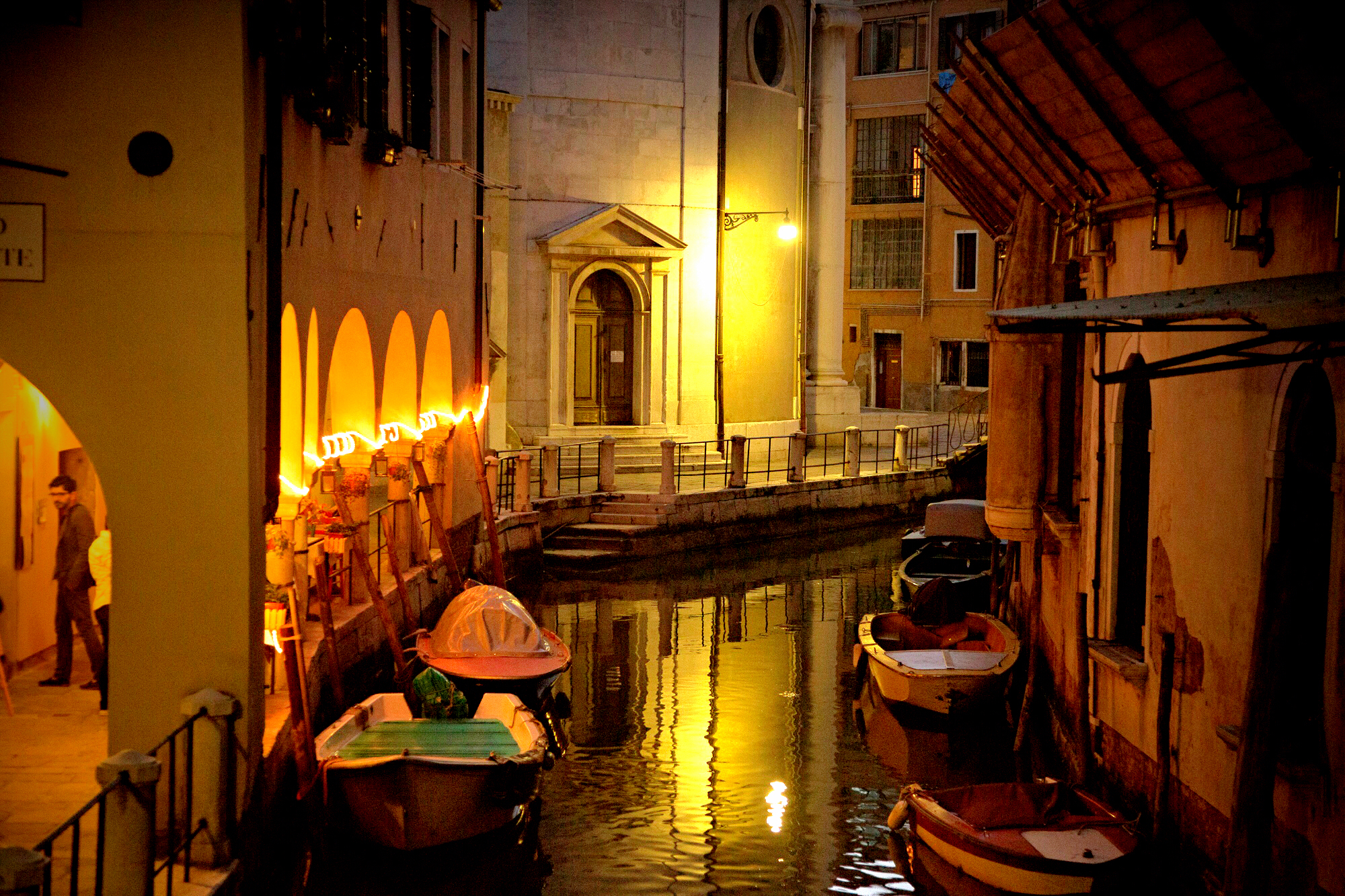
This was the atmosphere when we crossed the small Ponte Correr, a bridge that carries the name of one of the most illustrious families in Venice, after which the museum bordering one side of the Piazza San Marco is also named. The quietness all around was tangible, and the bridge's white steps were bathed in an eerie light that strongly contrasted against the dark water of the canal. The change in ambience between day and night we had witnessed was truly remarkable.


This was the atmosphere when we crossed the small Ponte Correr, a bridge that carries the name of one of the most illustrious families in Venice, after which the museum bordering one side of the Piazza San Marco is also named. The quietness all around was tangible, and the bridge's white steps were bathed in an eerie light that strongly contrasted against the dark water of the canal. The change in ambience between day and night we had witnessed was truly remarkable.
Bridge Ninety-Six - Ponte Pasqualigo
Retracing our steps, we once again joined the main route to the Santa Lucia station at the Ponte Pasqualigo, bridge number ninety-six.
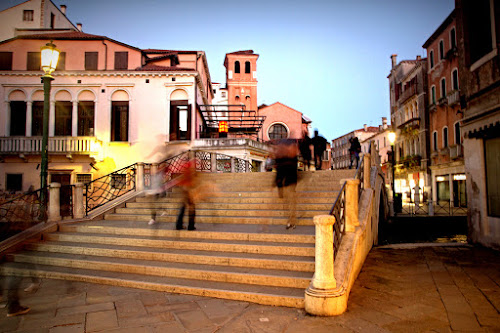
It's a stone bridge with broad steps, named after the last naval commander of the independent republic of Venice before it was conquered by Napoleon and subsequently ruled by Austria. It usually carries a dense stream of people, but at this hour it was relatively quiet with only a few passers-by moving along hurriedly - most probably the last of the day's commuters going home by train. It was now almost half-past eight in the evening, and most of the street lights were on and shop windows lit, even though the sky was still a powdery blue.
I had to start doing tricks with the camera to compensate for the almost total darkness, stretching exposure times and pushing the camera's settings to their limits. We'd better finish soon, or I'll be stuck with pitch-black photos!

It's a stone bridge with broad steps, named after the last naval commander of the independent republic of Venice before it was conquered by Napoleon and subsequently ruled by Austria. It usually carries a dense stream of people, but at this hour it was relatively quiet with only a few passers-by moving along hurriedly - most probably the last of the day's commuters going home by train. It was now almost half-past eight in the evening, and most of the street lights were on and shop windows lit, even though the sky was still a powdery blue.
I had to start doing tricks with the camera to compensate for the almost total darkness, stretching exposure times and pushing the camera's settings to their limits. We'd better finish soon, or I'll be stuck with pitch-black photos!
Bridge Ninety-Three - Ponte Priuli
Despite our tiredness we were now moving along at quite a pace - the winning post, so to speak, was in sight. So we moved on quickly from our previous bridge, the Ponte Molin de la Racheta and walked down the Calle de la Racheta to the Ponte Priuli, an iron bridge surrounded by apartment buildings where window boxes were showing the first colourful signs of spring with white, yellow and pink blooms, and succulents draping the sides in shades of grey and green.

The Priuli family were immigrants from Hungary, who rose to become part of the aristocracy and from whom were born several doges and cardinals. Not sure if they're still in the Venice telephone book though. Should check when we're done here, which should be in about an hour or so...

The Priuli family were immigrants from Hungary, who rose to become part of the aristocracy and from whom were born several doges and cardinals. Not sure if they're still in the Venice telephone book though. Should check when we're done here, which should be in about an hour or so...
Bridge Ninety-Two - Ponte Molin de la Racheta
After walking alongside the Rio de Santa Caterina for a while, we made a U-turn back across the canal using the Ponte Molin de la Racheta. It's a relatively new bridge, dating from 1901.

Walking along the Rio de Santa Caterina towards the Racheta Bridge, as it is commonly known, a splash of purple and green adorning the top of a high wall hinted at one the small, hidden treasures that subliminally dot the Venetian landscape - a walled garden. Apart from the Giardini and two or three other public gardens, there are no parcels of open greenery visible in Venice; it's all built-up and crammed together tightly, and the only breathing space is the occasional paved campo. Yet there are many plots in the backyards of palaces enclosed by three-metre-high walls where trees and shrubbery thrive. This is what the bright purple wisteria we're seeing now is about; it gives a hint of the patch of serenity that exists inside.
'Racheta' is a racket-and-ball game that used to be played in this area, perhaps in the small campo adjacent to the bridge. Right now we could hear and see a few youngsters kicking a football around in the campo, while two or three young mothers with their prams were watching from the benches on the perimeter. The game being played may have changed, but the rest of the scene was probably much the same as five hundred years ago.
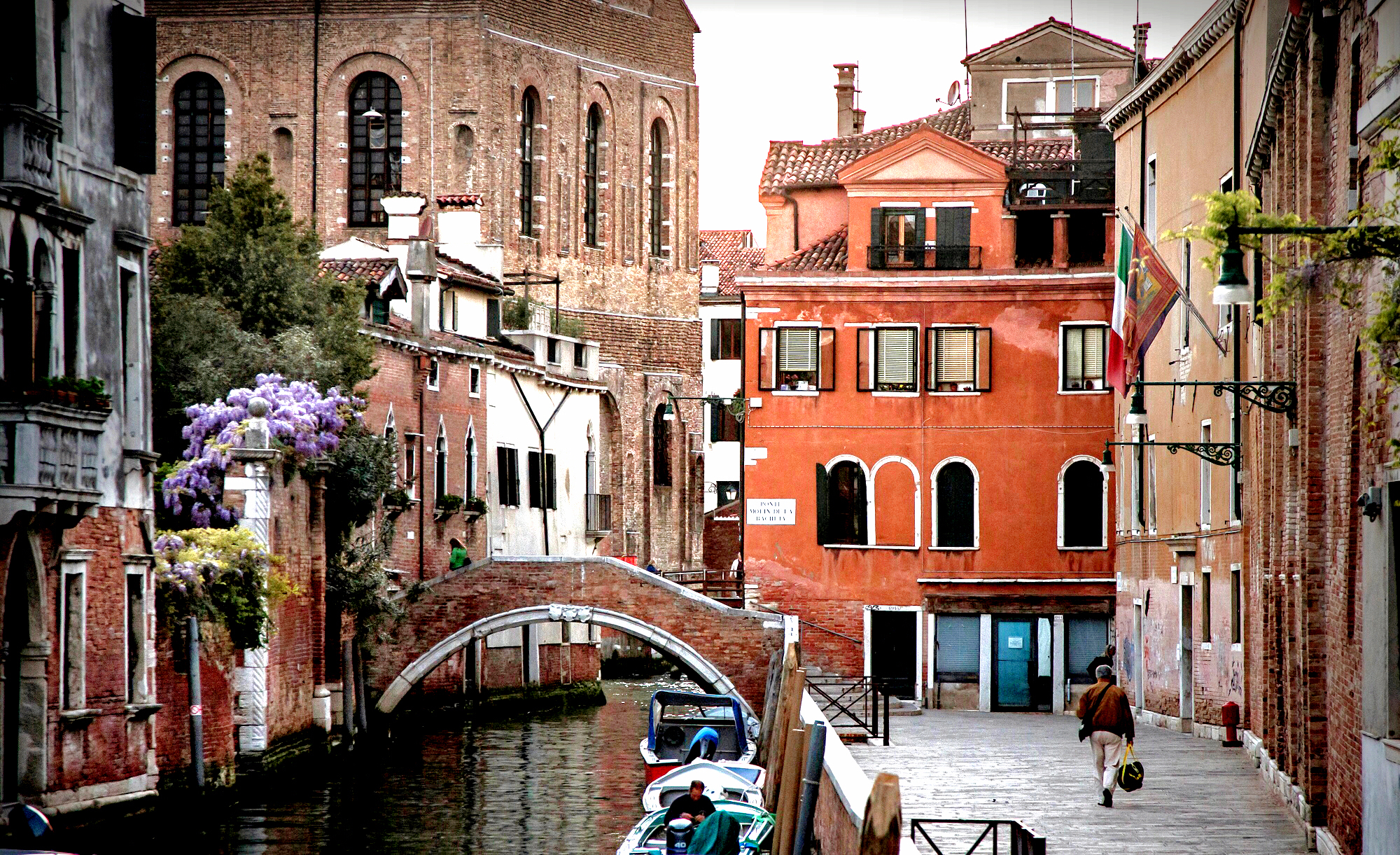
Walking along the Rio de Santa Caterina towards the Racheta Bridge, as it is commonly known, a splash of purple and green adorning the top of a high wall hinted at one the small, hidden treasures that subliminally dot the Venetian landscape - a walled garden. Apart from the Giardini and two or three other public gardens, there are no parcels of open greenery visible in Venice; it's all built-up and crammed together tightly, and the only breathing space is the occasional paved campo. Yet there are many plots in the backyards of palaces enclosed by three-metre-high walls where trees and shrubbery thrive. This is what the bright purple wisteria we're seeing now is about; it gives a hint of the patch of serenity that exists inside.
'Racheta' is a racket-and-ball game that used to be played in this area, perhaps in the small campo adjacent to the bridge. Right now we could hear and see a few youngsters kicking a football around in the campo, while two or three young mothers with their prams were watching from the benches on the perimeter. The game being played may have changed, but the rest of the scene was probably much the same as five hundred years ago.
Bridge Ninety-One - Ponte dei Gesuiti
Our next bridge, the Ponte dei Gesuiti, was only a few steps away along a street named Salizada Seriman. 'Salizada' means 'paved street', so it must have been unique and upmarket in an era - we're talking thirteenth century here - when streets generally consisted mostly of mud and dirt. The Ponte dei Gesuiti - Bridge of the Jesuits - is a broad stone-and-red-brick bridge across the Rio de Santa Caterina that, after the twilight of the salizada, opens up across the canal onto the light of the Campo dei Gesuiti, where the Jesuits once had a monastery.

The Jesuits had mixed fortunes in Venice, having been banned from the city in 1606 and again in 1773. Now there's a Carabinieri station in a building at the foot of the bridge; two buildings along the canal were cloaked in protective construction netting; a smartly dressed lady was taking her pooch for his afternoon walk across the campo, and generally I don't think anyone every crossing the bridge today would ever give a second thought to the idea that there was once religious strife. Such is the nature of time gone by, during which we have learnt how to live and let live. Or have we?


The Jesuits had mixed fortunes in Venice, having been banned from the city in 1606 and again in 1773. Now there's a Carabinieri station in a building at the foot of the bridge; two buildings along the canal were cloaked in protective construction netting; a smartly dressed lady was taking her pooch for his afternoon walk across the campo, and generally I don't think anyone every crossing the bridge today would ever give a second thought to the idea that there was once religious strife. Such is the nature of time gone by, during which we have learnt how to live and let live. Or have we?

Bridge Ninety - Ponte dei Sartori
We left the Campo dei Santi Apostoli behind and joined the Strada Nova, home to Venice's only McDonald's outlet. Its presence sets the tone for the general shopping experience in this area - it's geared towards the immediate gratification of day tourists, and little more. But perhaps this was a fortunate thing: for the past hour or so I've been running out of space on my camera's memory card, and have been stopping every now and then to delete unwanted photos - much to the chagrin of Adeline, who still kept an eye on our timing and reminded me of the impending nightfall. Fortunately we walked past a camera shop - one of surprisingly few in Venice - where I could quickly pop in and buy an additional memory card. Up to now, with about ten bridges to go, I've taken forty gigabytes' worth of photos, which equates to about nine hundred high resolution images. It's been a fruitful day so far!

Soon we swung right out of the Strada Nova, leaving behind most of the tourists and entering a quieter neighbourhood. Minutes later we were at the foot of our next bridge, the Ponte dei Sartori, that once was a stone bridge but is now a rusty-looking iron bridge with long, twirly-patterned railings. It connects a narrow alley, the Salizada del Spezier, at an angle over the Rio del Gozzi with the Fondamenta dei Sartori. 'Sartori' means 'tailors', and the bridge is named that way most likely because there was a hospice for poor tailors as well as the Scuola dei Sartori nearby.
We were footsore and tired, but there were only ten bridges to go before we're finished!

Soon we swung right out of the Strada Nova, leaving behind most of the tourists and entering a quieter neighbourhood. Minutes later we were at the foot of our next bridge, the Ponte dei Sartori, that once was a stone bridge but is now a rusty-looking iron bridge with long, twirly-patterned railings. It connects a narrow alley, the Salizada del Spezier, at an angle over the Rio del Gozzi with the Fondamenta dei Sartori. 'Sartori' means 'tailors', and the bridge is named that way most likely because there was a hospice for poor tailors as well as the Scuola dei Sartori nearby.
We were footsore and tired, but there were only ten bridges to go before we're finished!
Bridge Eighty-Nine - Ponte dei Santi Apostoli
It's a swift walk keeping along this busy tourist highway we're on, across two small campiellos and through a dark sotoportego and here we find ourselves at the base of the stone steps of Ponte dei Santi Apostoli.
Standing at the exit of the sotoportego and looking across the bridge we see the signature campanile of the Chiesa dei Santi Apostoli di Cristo, the Church of the Holy Apostles of Christ. The campanile's very unusual clock face has a shiny, flaring golden sunset in the centre of a set of numerals that are quite confusing at first glance. It runs from one to twelve downwards, and then from one to twelve upwards, so it's a sort of 'double clock'. It's as if it shows the time of day twice. Intriguing. A few times on the Challenge I've been sorry I didn't convince a local expert to accompany us to explain Venice's strange phenomena, such as this strange clock-face to us. Or perhaps that would have spoilt the mysterious appeal Venice holds for outsiders.

Chiesa dei Santi Apostoli di Cristo is one of eight churches started in the seventh century by St Magnus, and according to legend he was guided to this location by a vision of twelve cranes, and subsequently built the church here.
The campo that leads from the bridge to the church itself is a hub of stalls, sidewalk cafés and a few trees sprouting early spring green that makes for a friendly atmosphere in the fading daylight. A man was watching the bridge traffic from a window above the bridge, and for a moment I really, really wished to live up there, looking down onto the bridge and occasionally shouting a greeting and exchanging a few words with passers-by I recognised.

I wondered if he realised how privileged he was to wake to up the sight of the campanile every day, or whether he'd gotten used to it and mused on why countless tourists like us paused and stared in wonder.
Standing at the exit of the sotoportego and looking across the bridge we see the signature campanile of the Chiesa dei Santi Apostoli di Cristo, the Church of the Holy Apostles of Christ. The campanile's very unusual clock face has a shiny, flaring golden sunset in the centre of a set of numerals that are quite confusing at first glance. It runs from one to twelve downwards, and then from one to twelve upwards, so it's a sort of 'double clock'. It's as if it shows the time of day twice. Intriguing. A few times on the Challenge I've been sorry I didn't convince a local expert to accompany us to explain Venice's strange phenomena, such as this strange clock-face to us. Or perhaps that would have spoilt the mysterious appeal Venice holds for outsiders.

Chiesa dei Santi Apostoli di Cristo is one of eight churches started in the seventh century by St Magnus, and according to legend he was guided to this location by a vision of twelve cranes, and subsequently built the church here.
The campo that leads from the bridge to the church itself is a hub of stalls, sidewalk cafés and a few trees sprouting early spring green that makes for a friendly atmosphere in the fading daylight. A man was watching the bridge traffic from a window above the bridge, and for a moment I really, really wished to live up there, looking down onto the bridge and occasionally shouting a greeting and exchanging a few words with passers-by I recognised.

I wondered if he realised how privileged he was to wake to up the sight of the campanile every day, or whether he'd gotten used to it and mused on why countless tourists like us paused and stared in wonder.
Bridge Eighty-Eight - Ponte San Giovanni Grisostomo
Dusk was now fast approaching, and more shop window lights were coming on, contrasting with the fading light over the canals and in the alleys. The city's breathing seemed to slow down as it readied itself for nightfall.

Ponte San Giovanni Grisostomo is almost like a sister bridge to the previous bridge we visited, Ponte de l'Ogio. It's similar in style with broad stone steps, weathered-looking railing pillars and a slightly more simple iron railing design. The general surroundings also have the same gritty appearance - lots of random scribbles on the walls, fading paint and a visual cacophony of signage and notifications, inviting passers-by to an Italian lesson and a classical music concert, among other. It's a perfect set for a gothic-inspired, post-apocalyptic sci-fi movie, yet I believe for the average tourist it is the face of romantic Venice they'll remember.

Who was the saint the bridge is named after? San Giovanni Grisostomo - Saint John Chrysostom - was an early church father whose epithet Chrysostom means 'golden-mouthed', thus gifted orator. As with the earthly remains of many other clerics of the early church, his relics have a colourful history - at least four places claim to be in possession of his skull, including the Basilica di Santa Maria del Fiore in Florence and the Dal Pozzo chapel in Pisa.

Ponte San Giovanni Grisostomo is almost like a sister bridge to the previous bridge we visited, Ponte de l'Ogio. It's similar in style with broad stone steps, weathered-looking railing pillars and a slightly more simple iron railing design. The general surroundings also have the same gritty appearance - lots of random scribbles on the walls, fading paint and a visual cacophony of signage and notifications, inviting passers-by to an Italian lesson and a classical music concert, among other. It's a perfect set for a gothic-inspired, post-apocalyptic sci-fi movie, yet I believe for the average tourist it is the face of romantic Venice they'll remember.

Who was the saint the bridge is named after? San Giovanni Grisostomo - Saint John Chrysostom - was an early church father whose epithet Chrysostom means 'golden-mouthed', thus gifted orator. As with the earthly remains of many other clerics of the early church, his relics have a colourful history - at least four places claim to be in possession of his skull, including the Basilica di Santa Maria del Fiore in Florence and the Dal Pozzo chapel in Pisa.
Bridge Eighty-Six - Ponte di Rialto
It was early evening now. The day-tourist crowds were thinning out and many of the workers were leaving the island to their homes in Mestre. Not that the city became dead quiet, it just means, especially for these two intrepid bridge-walkers, that one didn't have to fight against a throng of people along the main routes in the city. The bridges became a little more quiet, and the gondoliers were noticeably fewer.

We now crossed the bridge that most defined Venice as a city of bridges: Ponte di Rialto, the most photographed, most recognised, and most visible icon of the city. We walked across it three or four times, stopping at the top, briefly browsing the souvenir shops along its staircase and peeking around the bottom corners at the reliefs decorating the sides.
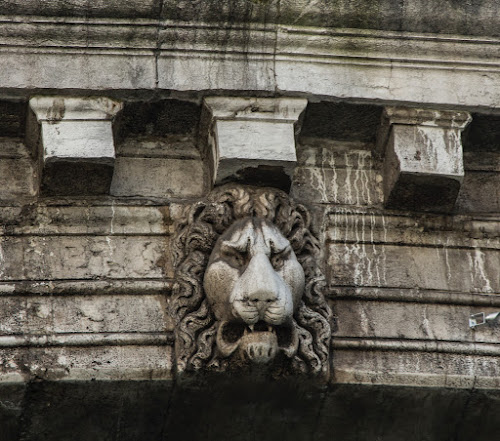
All that could be possibly written about the Ponte di Rialto has already been put to paper. Every self-respecting tour guide knows that the first version of the bridge was built in 1255; that a wooden version of it collapsed twice (in 1444 and 1524) under the weight of crowds watching regattas on the Grand Canal, and that the present stone bridge dates from 1591. Today, despite it being in dire need of a facelift, it remains an impressive icon with the biggest wow-factor in Venice.
I scanned the bridge with a photographer's eye, looking for new angles and new interpretations of the Ponte di Rialto. Perhaps a black and white view, or perhaps something with a wide angle? I took a few photographs, and promised myself to return in the following days. Because right now, we had fourteen bridges to complete, and light was fading fast.

We now crossed the bridge that most defined Venice as a city of bridges: Ponte di Rialto, the most photographed, most recognised, and most visible icon of the city. We walked across it three or four times, stopping at the top, briefly browsing the souvenir shops along its staircase and peeking around the bottom corners at the reliefs decorating the sides.

I scanned the bridge with a photographer's eye, looking for new angles and new interpretations of the Ponte di Rialto. Perhaps a black and white view, or perhaps something with a wide angle? I took a few photographs, and promised myself to return in the following days. Because right now, we had fourteen bridges to complete, and light was fading fast.
Bridge Eighty-Five - Ponte de la Pescaria
We now followed a walkway that took us, once again, to the bank of the Grand Canal. We went along the Fondamenta del’Ogio for a while, passing open courtyards with sidewalk cafes where people were sitting outside enjoying sundowners, as the day was by now fading into dusk. A few more steps further we reached Ponte de la Pescaria, gateway to probably the most colourful and vibrant spot in Venice - you guessed it - the fish and fresh produce market.

The Ponte de la Pescaria enters the fish and fresh produce market area through a short flight of stairs leading directly into a Byzantine doorway. We'd visited the market the day before to stock up on fresh greens for the week, but now the only reminder that the pillared area has been a fish market for eight hundred years was a vague maritime smell that in some corners was rather pungent. Now it was deserted, and remains so for the next ten hours. Tomorrow morning the market will once again awaken when the stall holders arrive around six to keep the city fed. But we didn't mind that it was empty right now; that made it easier to move around unhindered and examine the sculpted figurines on top of the pillars holding up the roof of the market.

All them had a maritime theme; there were fishes, boats, and a bronze fisherman with a fishing net in hand. The market wasn't always housed in such a smart and artistically rich building; it's only in 1907 when the present structure housing the market was erected, based on an artwork rather than an architectural plan. It's here, more than anywhere else I realise how close the spirit of Venice is intertwined with the ocean. It's a city at one with the sea.

The Ponte de la Pescaria enters the fish and fresh produce market area through a short flight of stairs leading directly into a Byzantine doorway. We'd visited the market the day before to stock up on fresh greens for the week, but now the only reminder that the pillared area has been a fish market for eight hundred years was a vague maritime smell that in some corners was rather pungent. Now it was deserted, and remains so for the next ten hours. Tomorrow morning the market will once again awaken when the stall holders arrive around six to keep the city fed. But we didn't mind that it was empty right now; that made it easier to move around unhindered and examine the sculpted figurines on top of the pillars holding up the roof of the market.

All them had a maritime theme; there were fishes, boats, and a bronze fisherman with a fishing net in hand. The market wasn't always housed in such a smart and artistically rich building; it's only in 1907 when the present structure housing the market was erected, based on an artwork rather than an architectural plan. It's here, more than anywhere else I realise how close the spirit of Venice is intertwined with the ocean. It's a city at one with the sea.
Bridge Eighty-Four - Ponte dei Morti o della Chiesa
In any other city the area around the Ponte dei Morti o della Chiesa will probably be declared unsafe to live in, and the buildings summarily demolished and fancy new apartment buildings erected. But what I've learnt about many of the buildings in Venice is that the almost omni-present decay one sees on the outside often hides smart, modern and too-expensive apartments on the inside. Don't be fooled by a building that looks like it hasn't been repaired since Napoleon's time and houses nothing else but squatters and rats. It may just be housing the upmarket boutique hotel you book yourself into on your next visit.
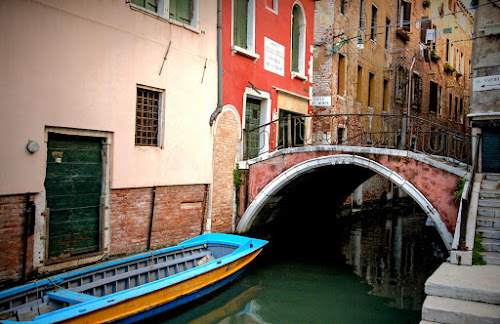
Not that the Ponte dei Morti o della Chiesa is in bad shape at all. It's one of those smart stone bridges with a broad stairway and a simple iron railing that were in vogue in the nineteenth century and have been fairly well looked after since. Bridges, I suspect, are built to last much longer than dwellings in Venice.
The name of the bridge literally means "the dead, or of the church". The church referred to is the San Cassiano church and the 'dead' are those who lay in its graveyard, which existed before the graveyards in Venice were moved to the island of San Michele. It started life as a stone bridge in 1488, replaced by a wooden one in 1502, and rebuilt once again in stone in 1615. And that's the one we're looking at now.

Not that the Ponte dei Morti o della Chiesa is in bad shape at all. It's one of those smart stone bridges with a broad stairway and a simple iron railing that were in vogue in the nineteenth century and have been fairly well looked after since. Bridges, I suspect, are built to last much longer than dwellings in Venice.
The name of the bridge literally means "the dead, or of the church". The church referred to is the San Cassiano church and the 'dead' are those who lay in its graveyard, which existed before the graveyards in Venice were moved to the island of San Michele. It started life as a stone bridge in 1488, replaced by a wooden one in 1502, and rebuilt once again in stone in 1615. And that's the one we're looking at now.
Bridge Eighty-Three - Ponte del Ravano
Ponte del Ravano is a functional stone bridge connecting two long, narrow calli.

Looking around while standing on its crest, I didn't see much distinctive about it but then something caught my eye: a stencilled piece of street art painted in fading black just below the top of the parapet with the wording 'Wake up Italy'. Obviously a passing artist had the opinion that Italy was asleep.

I know lots of people – many of them Italian – who'd laugh and agree, what with three-hour siestas and spritzers before ten in the morning being part of life in Venice. But other than that I don't think Italy has much waking up to do – they are who they are, and Venice is simply the stamp of the character of a people whose intense love of the goodness in life is infectious and wonderful.

Looking around while standing on its crest, I didn't see much distinctive about it but then something caught my eye: a stencilled piece of street art painted in fading black just below the top of the parapet with the wording 'Wake up Italy'. Obviously a passing artist had the opinion that Italy was asleep.

I know lots of people – many of them Italian – who'd laugh and agree, what with three-hour siestas and spritzers before ten in the morning being part of life in Venice. But other than that I don't think Italy has much waking up to do – they are who they are, and Venice is simply the stamp of the character of a people whose intense love of the goodness in life is infectious and wonderful.
The Bridges of Venice: Renovating the renovations
The bridges in Venice today is, of course, hardly exactly the same bridges from a few hundred years ago, when they were first constructed.
The majority of them have been reconstructed, or at least renovated, at least two or three time since then. Most of the early bridges of Venice were made from wood and therefore prone to fires that were quite prevalent in the early days. Natural decay also caused the bridges to simple rot away after some time. So the next phase of bridge renovation was the replacement of the first generation of bridges – which were sometimes no more than narrow walkways – with longer lasting Istrian stone bridges. Many bridges became stone structures during the mid-nineteenth century, as the dates on them attest.

With industrialisation came the art of cast iron, resulting in some bridges becoming iron structures with ornate railings.
Today there are very few wooden bridges left in Venice, of which the Accademia bridge is the most famous example, even if its construction is a mix of wood and steel. Since wooden bridges need more regular maintenance than other bridges, these are also the bridges that, ironically, look the most brand spanking new of all.

The different states the bridges are in, and the plaques on bridges indicating when they were last renovated – many of them in the mid-to late 1800's and the beginning of the 21st century – tells a story of renovations that are barely keeping up with the rate of decay. Foliage growing from cracks in stone bridges and an almost translucent green layer of moss and algae covering their bases may be pretty to look at but is a sure sign of a bridge that will need renovation in the next few years.

In some cases iron bridges we’ve seen are starting to show rust damage due to a lack of painting. Others we’ve passed over are clearly newly renovated, or in the process thereof. A few years ago Venice appointed a company to look after the bridges, and the fact that most bridges are sturdy and safe means there’s no doubt that well-looked after bridges, especially those on major tourism routes, are a priority. In a harsh environment like in Venice, which is constantly battling the onslaught of the natural elements, there is inevitably a never-ending cycle of upkeep and renewal. There's a delicate balance that has to be struck between heritage and historic value on the one hand, and practicality, safety and economics on the other.

The majority of them have been reconstructed, or at least renovated, at least two or three time since then. Most of the early bridges of Venice were made from wood and therefore prone to fires that were quite prevalent in the early days. Natural decay also caused the bridges to simple rot away after some time. So the next phase of bridge renovation was the replacement of the first generation of bridges – which were sometimes no more than narrow walkways – with longer lasting Istrian stone bridges. Many bridges became stone structures during the mid-nineteenth century, as the dates on them attest.
With industrialisation came the art of cast iron, resulting in some bridges becoming iron structures with ornate railings.
Today there are very few wooden bridges left in Venice, of which the Accademia bridge is the most famous example, even if its construction is a mix of wood and steel. Since wooden bridges need more regular maintenance than other bridges, these are also the bridges that, ironically, look the most brand spanking new of all.

The different states the bridges are in, and the plaques on bridges indicating when they were last renovated – many of them in the mid-to late 1800's and the beginning of the 21st century – tells a story of renovations that are barely keeping up with the rate of decay. Foliage growing from cracks in stone bridges and an almost translucent green layer of moss and algae covering their bases may be pretty to look at but is a sure sign of a bridge that will need renovation in the next few years.

In some cases iron bridges we’ve seen are starting to show rust damage due to a lack of painting. Others we’ve passed over are clearly newly renovated, or in the process thereof. A few years ago Venice appointed a company to look after the bridges, and the fact that most bridges are sturdy and safe means there’s no doubt that well-looked after bridges, especially those on major tourism routes, are a priority. In a harsh environment like in Venice, which is constantly battling the onslaught of the natural elements, there is inevitably a never-ending cycle of upkeep and renewal. There's a delicate balance that has to be struck between heritage and historic value on the one hand, and practicality, safety and economics on the other.

Bridge Eighty-Two - Ponte del Forner
The neat-looking Ponte del Forner leads right up to the relief-adorned doorway of the Palazzo Agnus Dio, an ancient family home now used as an exhibition space.

Above the entrance is a stone relief of two angels holding up a shield that once depicted the coat of arms of the original owners.

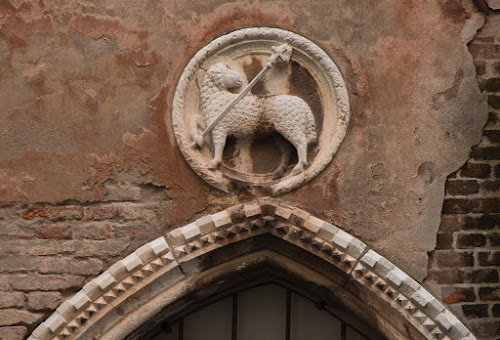
Next to the doorway is a water-level door with a small patera with a relief depicting a lamb and a staff with a cross at one end, that probably once served as the family's good luck charm but is now used as the venue's logo. Isn't that a wonderful example of the changing meaning of cultural artefacts?


Above the entrance is a stone relief of two angels holding up a shield that once depicted the coat of arms of the original owners.

Next to the doorway is a water-level door with a small patera with a relief depicting a lamb and a staff with a cross at one end, that probably once served as the family's good luck charm but is now used as the venue's logo. Isn't that a wonderful example of the changing meaning of cultural artefacts?


Bridge Eighty and Eighty-One - Ponte de Ca'Giovanelli and Ponte Pesaro
From Ponte del Megio we made our way in the direction of the Grand Canal. A few minutes later we found ourselves in front of one of the proudest churches facing the Canal: San Stae. The church has a nice little campo in front of it, perfect for sitting down at the water's edge and watching the Grand Canal's never-ending stream of vaporettos, transport boats, taxis and vessels of all types.

The vessel that stood out among the dozens that passed during the half an hour or so we took a break here was the blood red firefighters' boat. It cruised past at a leisurely pace so its four-man was most likely just spending a quiet afternoon making sure the boat was in good running order. Judging by their casual behaviour and lack of equipment, they didn't look like they were ready to climb through a smoking building and rescue a trapped old lady from the fourth floor window.

The Ponte de Ca' Giovanelli is a cute, small iron bridge by the side of the campo. It was renovated relatively recently in 2004.

It leads from the campo where we paused, across the Rio San Stae into an alley that went to our next bridge nearby, the Ponte Pesaro. If you're familiar with Venice you'll know that's also the name of one of the most-visited museums in Venice, the Ca' Pesaro. We paused only briefly at the closed, pillar-framed gate of the museum - it was now almost seven in the evening - and walked briskly on, followed a bend in the alley away from the canal and moments later we were at the Ponte del Forner. Such are the bridges of Venice - mostly three minutes away from each other, and never more than a ten-minute walk apart.

The vessel that stood out among the dozens that passed during the half an hour or so we took a break here was the blood red firefighters' boat. It cruised past at a leisurely pace so its four-man was most likely just spending a quiet afternoon making sure the boat was in good running order. Judging by their casual behaviour and lack of equipment, they didn't look like they were ready to climb through a smoking building and rescue a trapped old lady from the fourth floor window.

The Ponte de Ca' Giovanelli is a cute, small iron bridge by the side of the campo. It was renovated relatively recently in 2004.

It leads from the campo where we paused, across the Rio San Stae into an alley that went to our next bridge nearby, the Ponte Pesaro. If you're familiar with Venice you'll know that's also the name of one of the most-visited museums in Venice, the Ca' Pesaro. We paused only briefly at the closed, pillar-framed gate of the museum - it was now almost seven in the evening - and walked briskly on, followed a bend in the alley away from the canal and moments later we were at the Ponte del Forner. Such are the bridges of Venice - mostly three minutes away from each other, and never more than a ten-minute walk apart.
Subscribe to:
Posts (Atom)